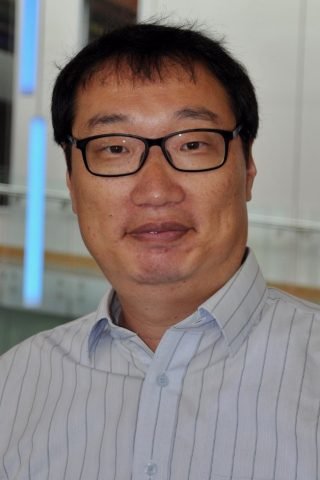
Samuel Cho
About
I graduated from Seoul National University in Seoul, Korea with a BS degree, cum laude, in Electrical Engineering. I traded my summa cum laude with a 1000 page programming book that I wrote when I graduated. After coming to the USA, I could earn my MS degree (Electronic Design Automation) from the University of California at Berkeley in Electrical Engineering and Computer Science. Ultimately, after returning to academia from software industry, I could earn my PhD degree (Software Engineering and Systems) in Electrical and Computer Engineering from the University of Texas at Austin. My main research is software engineering, specifically application of software engineering to solve real world problems including Pervasive Computing and Internet of Things. I believe software engineering tools, methodologies, philosophies, design approaches, systems thinking, and processes can be used to to solve broader types of problems outside software development—individual, team, and even country development. This is a real bio in the sense that I can show you some nice papers that have the names of institutions that I described above. I also can show you the real academic papers and programming books that I have written so far. However, I call this fake because I believe engineering, especially software engineering, is about making products not earning papers. I was hooked right away when I first learned about programming in my freshman year. I was so fascinated about programming that I decided to learn everything about computers whatever that might be. This led to my co-founding a startup company, with great colleagues, where I developed virtually all kinds of software including web, desktop, embedded, and VHDL. Our product received the Presidential Award to show that even a small team can change the world a little bit. Furthermore, as a by-product, I could learn various software engineering theories and implementation skills. Later, I worked for a company that develops world-class software products, where I learned another aspect of software engineering—processes and control. Luckily in there, my idea was selected as one of the top features of the year. I was also lucky enough to be involved in many types of research software engineering tools including Eclipse, EDA tools, SAT solvers, and most importantly my own invention “ChitChat” that was awarded the best paper from one of the top conferences. This is a fake bio in the sense that these results are just by-products of my fulfilling curiosity and understanding the world. However, I call this real because I believe these are the proof that I love programming and everything about computers, and I think my proof is by making real-world products that people use. I always feel excited when I think how great things that NKU students can achieve "when they understand their potential, and they decide to realize their potential to the limit." I believe my job is to help them to understand and realize, and make ready for their great journey.
Research Performance Summary
First Recorded Paper
An improved VLSI architecture for Viterbi decoder
Year: 1999
Citations: 4
Venue: Proceedings of IEEE. IEEE Region 10 Conference. TENCON 99.'Multimedia
Latest Recorded Paper
P4: Principles, Patterns, Practices, and Projects for Effective Software Engineering Education.
Year: 2024
Citations: 1
Venue: MIPRO
Last 10 Years Publication Activity
This timeline shows the professor's yearly publication activity.